


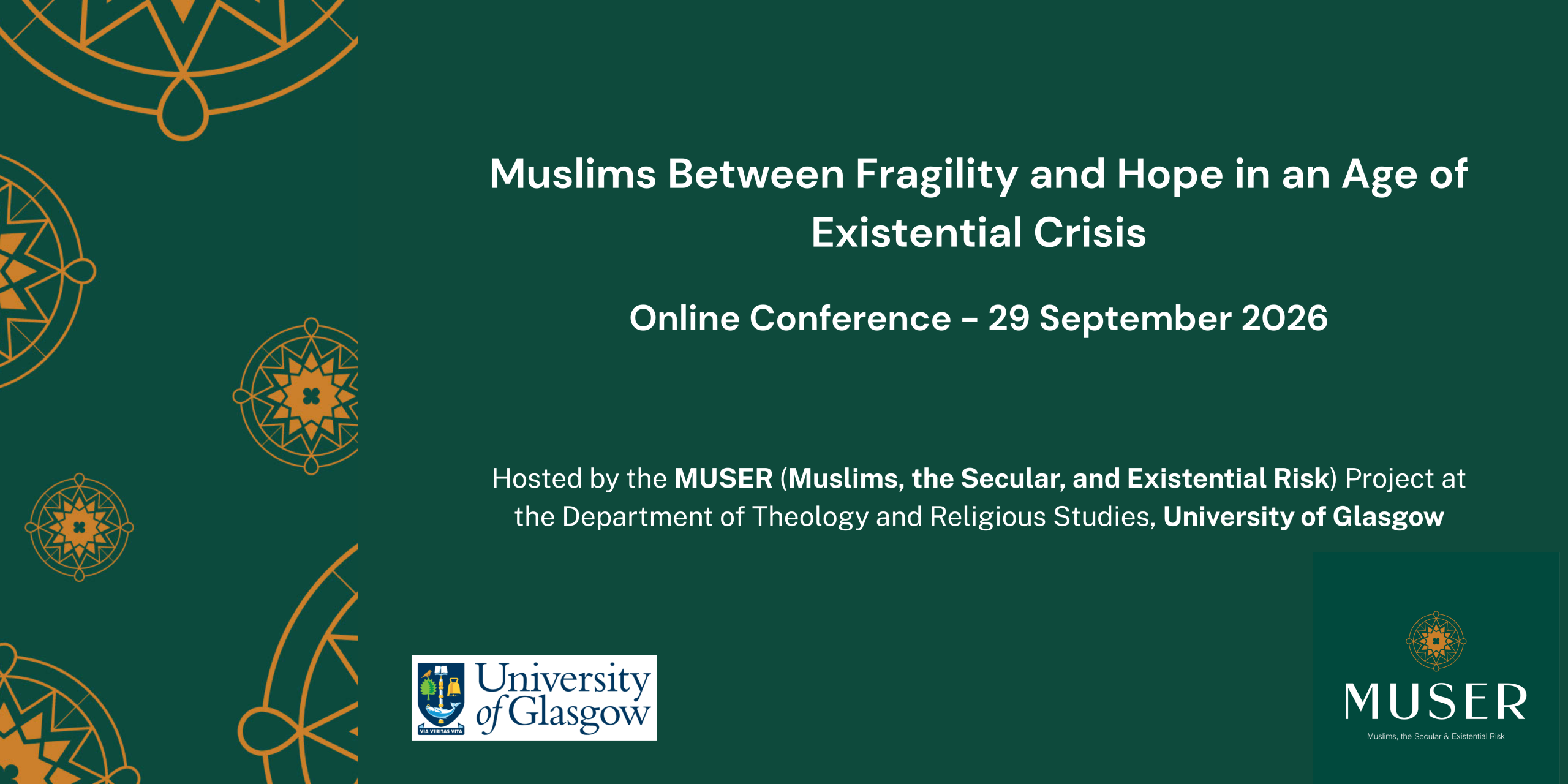
MUSER Conference (Online)
An international online conference exploring Muslim perspectives on existential risk, human fragility, and hopeful futures.
📅 Tuesday, 29 September 2026, 9:00 AM – 5:30 PM (BST)
💻 Online (Microsoft Teams), hosted by the Department of Theology & Religious Studies, University of Glasgow
Humanity faces unprecedented global challenges from climate change and artificial intelligence to war, pandemics, and nuclear threats. Yet conversations about existential risk rarely include religious perspectives.This one-day international conference brings together scholars from around the world to explore how Muslims understand, experience, and respond to existential risk. Through perspectives drawn from theology, anthropology, history, philosophy, sociology, and related disciplines, conference presentations will examine how the concepts of fragility and hope shape Muslim engagements with the contemporary world.Hosted by the MUSER Project at the Department of Theology and Religious Studies, University of Glasgow, the conference seeks to broaden discussions of existential risk by foregrounding Islamic intellectual traditions and lived Muslim experiences.
The conference will be of interest to academics, theologians, anthropologists, social scientists, decolonial scholars, and anyone interested in faith perspectives and contemporary global crises.
Event Registration
Registration for the conference is free and includes access to all conference sessions, live Q&A, and conference updates. Please register for the conference HERE.
Conference Programme
Muslims Between Fragility and Hope in an Age of Existential Crisis
Online Conference – 29 September 2026
09:00 - 09:15
Welcome
09:15 - 10:45
Panel 1
10:45 - 11:00
Break
11:00 - 12:30
Panel 2
12:30 - 13:30
Lunch Break
13:30 - 15:00
Panel 3
15:00 - 15:15
Break
15:15 - 16:45
Panel 4
16:45 - 17:00
Closing/ Plenary
Panels and Papers
Panel 1
Reconfiguring Muslim Selfhood between Hope and Fragility
-
Lisa Franke: “Reconfiguring Imān: Muslim Engagements with Ethical Uncertainties and Existential Crises”
-
Iqbal Akhtar: “Hijra as Hope: Migration Theology and Muslim Responses to Existential Displacement”
-
Amina Tawasil: “Surveillance, Affect, and the Logic of Protection: Fragility and Hope in Muslim Ethnographic Fieldwork in Iran”
Panel 2
Theological Issues of Hope and Fragility
-
Mazin Almas: “Between Ajal and Shafāʿ a: Al- Māturīdī’s Eschatological Theology and Rethinking Existential Risk”
-
Gregory Vandamme: “The Providential Threshold of Existential Risk: Ibn ʿAjība on Plague, Metaphysical Causality, and Ethical Response”
-
Osman Eltayib: “Fasād, Mīzān, and Iṣlāḥ: Ecological Fragility and Moral Repair in Islamic Environmental Ethics”
Panel 3
Muslim Thinkers’ Engagement with Hope and Fragility
-
Ibrahim Ozdemir: “Said Nursi and the Secular Void: Existential Risk, Meaning, and the Islamic Philosophical Alternative”
-
Mahnoor Farooqi: “Between Fragility and Becoming: Iqbal’s Khudi and Historical Time”
-
Saida Mirsadri: “Rethinking Evil in an Age of Existential Risk: Muhammad Iqbal and the Reconstruction of Islamic Responses to Suffering”
Panel 4
Topography of Hope and Fragility
-
Cecilee Glaus Jones: “Making oddkin in polycrisis: Muslim- Indigenous relations in the Greater Toronto Area”
-
Anika Kabani: “If it’s meant for me to get asylum, then God will help me’: Muslim Hope, Bureaucratic Fragility,and Risk in the United States”
-
Alice Catanzaro: “Spiritual (In)Security: Religious Chaos and Risk in Morocco”


